
Q2 Merchant sales down -1.2% year-on-year. Prices rise +5.8%. Volumes fall -6.6
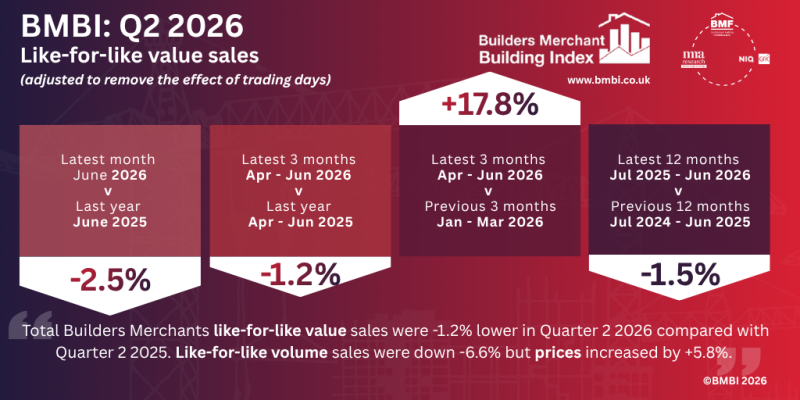
The latest Builders Merchant Building Index (BMBI) report reveals builders’ merchants’ Q2 2026 like-for-like value sales, adjusted to remove the impact of trading days, -1.2% lower than Q2 2025. Like-for-like volume sales were down -6.6%, but prices increased +5.8%.
With no difference in trading days, unadjusted Q2 total value sales were also down -1.2% year-on-year. By value, only three of the twelve categories sold more: Services (+7.3%), Workwear & Safetywear (+4.5%) and Miscellaneous (+2.3%). Of the two largest categories, Heavy Building Materials fell -2.6%, while Timber & Joinery Products was flat (0.0%). Renewables & Water Saving (-3.8%) was the weakest category.
June’s 2026 like-for-like value sales were -2.5% lower than June the year before. June’s like-for-like volume sales fell -10.0% while prices increased +8.4%. With one extra trading day in June 2026 compared to June 2025, unadjusted total value sales were +2.2% higher year-on-year. Unadjusted volume sales were -5.7% lower and prices were up +8.4%.
Nine categories sold more by unadjusted value with Services (+11.7%), Workwear & Safetywear (+11.1%), and Miscellaneous (+9.7%) performing best. Heavy Building Materials was up just +0.5% but Timber & Joinery Products (+3.1%) outperformed Total Builders Merchants (+2.2%). The joint weakest categories were Ironmongery (-1.1%) and Renewables & Water Saving (-1.1%).
In the 12 months July 2025 to June 2026, like-for-like value sales were down -1.5% compared to the previous 12-months (July 2024 to June 2025). Like-for-like volume sales were down -4.3% but prices increased +2.9%. With no difference in trading days, unadjusted value sales were also -1.5% lower. By unadjusted value, seven categories sold more, led by Renewables and Water Saving (+8.5%). Timber and Joinery Products grew by +1.0%, while Heavy Building Materials was weakest (-3.7%).
Mike Rigby, MD of MRA Research who produce this report, says: “Overall construction output is anaemic, as the latest ONS data reveals a +0.3% increase in Q2 output compared to Q1 but
-2.0% lower than Q2 2025. Five out of the nine construction sectors grew in Q2 2026 with infrastructure new work, the strongest up, +1.9%.
“Despite monthly construction output falling -0.1% in June, following a decrease of -0.8% in May, and a decrease of -0.1% in April, the overall level of output in Q2 was higher than in Q1, the ONS says, because the fall in April 2026 followed a particularly strong March.
“Housebuilding continues to meet significant headwinds. The latest National House Building Council (NHBC) numbers put Q2 new home registrations down -4.0% year-on-year, with cost pressures and geopolitical uncertainty affecting house builders’ performance. The prolonged dry weather has also thrown a new issue into the mix – water. Analysis by Public First, commissioned by Water UK, shows that England only has sufficient water for 420,000 of the 1.5 million homes the government wants built during its parliamentary term.
“The appointment of Andy Burnham as Prime Minister has lifted spirits though. Alongside England’s World Cup success and months of wall-to-wall sunshine, the GfK Consumer Confidence Index is looking more optimistic, with August’s figure showing a three-point overall improvement compared to July, and a five-point increase in people’s views on the general economic situation over the coming 12 months. Better yet, there was a five-point jump in the Major Purchase Index; a good omen for residential RMI projects.”
Set up and run by MRA Research, the BMBI – a brand of the Builders Merchants Federation – is a monthly index of builders’ merchant sales, and the most reliable, up-to-date measure of Repair, Maintenance, and Improvement (RMI) activity in the UK. The index is based on actual sales from NiQ GfK’s Builders’ Merchant Point of Sale Tracking Data, which captures value sales out to builders from generalist builders’ merchants, accounting for 88% of total sales from builders’ merchants throughout Great Britain. An in-depth review, which includes commentary by sector experts, is provided each quarter.